

Christian Menefee’s campaigning style has a subtle power—less show, more substance. While many politicians try to out-shout the cacophony, he’s been out-thinking it, often structuring his arguments like a good attorney moving toward a verdict. And that strategy just turned out to be incredibly successful in Houston’s competitive political field.
At 37, Menefee has already secured a couple of notable firsts. He was the youngest person ever elected as Harris County Attorney and the first Black American to hold that post. But perhaps what sets him apart most isn’t the résumé—it’s the posture. Thoughtful, deliberative, and often softly compelling, he handles governance like a responsibility, not a show.
In the runoff for Texas’s 18th Congressional District, a seat left vacant after the tragic loss of Sylvester Turner, Menefee’s success was more than a political gain—it was a recalibration. The race had been a struggle between legal experience and public-facing legacy. His rival, Amanda Edwards, a former member of the municipal council, added charm and experience with the area. But Menefee brought preparation—policy depth layered with legal fluency and organizational precision.
He prevailed. Not explosively. But decisively.
By entering into this position, Menefee tightens the margin in the U.S. House, decreasing the Republican lead to a notably shaky 218–214. That adjustment alone adds weight. In a gridlocked chamber, where even a single swing vote might sway the balance, his arrival hits like a quiet gavel strike—subtle, yet crucial.
| Category | Details |
|---|---|
| Full Name | Christian Dashaun Menefee |
| Date of Birth | April 18, 1988 (Age 37) |
| Birthplace | Houston, Texas, United States |
| Education | University of Texas at San Antonio; Washington University in St. Louis |
| Profession | Attorney, Politician |
| Historic Milestone | Youngest and first Black Harris County Attorney (elected 2020) |
| Congressional District | Texas’s 18th Congressional District |
| Office Elected | U.S. Representative (elected via 2026 special election) |
| Political Party | Democratic Party |
| Campaign Website | www.christianmenefee.com |
| External Biography Link | Wikipedia – Christian Menefee |
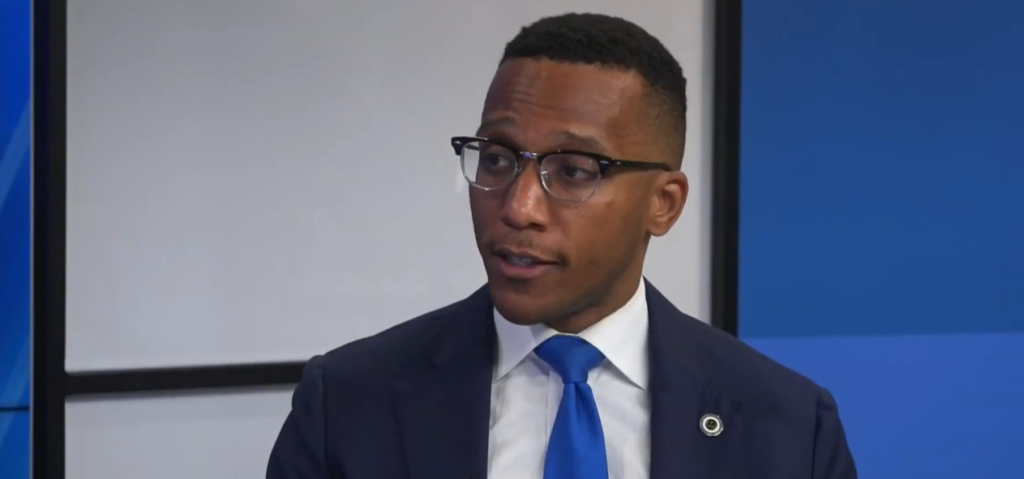
He enters Congress not as a brand, but as a builder. As County Attorney, Menefee tackled difficult state-level cases, initiating lawsuits that challenged unfair redistricting and pushed for access to reproductive healthcare. His court filings didn’t chase headlines. They chased impact. And more often than not, they landed.
His campaign has been remarkably disciplined over the last few months. His team focused on extremely effective, community-based outreach rather than overcrowding the airwaves. The kind of block-by-block ground game that often gets missed in national news, but proves extraordinarily durable when tested by genuine voter turnout.
I remember watching one of his earlier campaign events livestreamed from a tiny community facility on the north side of Houston. He wasn’t flanked by celebrities or party bosses. Just a few folding seats, a printed banner, and a tone of genuine engagement. What struck me was his ease—not fake confidence, but trained comfort. He was guiding people through a concept rather than pitching it.
Menefee’s success is particularly noteworthy in the context of a Congress facing renewed tension over immigration policy, climate resilience funding, and federal healthcare expansion. These aren’t just talking points for his district—they’re critical requirements. Houston continues to be one of the nation’s most economically diversified and climate-vulnerable cities. It requires nuanced federal partners.
Menefee established himself as a legal expert and a policy translator by forming strategic alliances with unions, grassroots organizations, and progressive legal networks. His message wasn’t just about pushing Washington—it was about equipping Houston with a better seat at the table.
By using his legal history, he’s entering federal politics already conversant in regulatory jargon. That is extremely valuable. While many freshmen members spend their first term adapting to committee protocol and procedural etiquette, Menefee enters ready to contribute—substantively and fast.
In the next months, he’ll be entrusted with managing a range of controversial votes. Some will require ideological clarity. Others will demand compromise. What makes Menefee particularly well-suited for this is his tendency to define disagreement not as a crisis, but as a process.
Since the launch of his campaign, he’s emphasized the importance of procedural reform—not in the abstract, but in terms of how laws can be shaped to actively serve working families. He has demonstrated a strong commitment to structural inclusion in everything from housing policy to healthcare equity.
His presence also points to the markedly better trajectory of Democratic organizing in Texas. Over the previous few cycles, Houston has seen a rebound in labor participation and young turnout. Without exaggerating it, Menefee’s campaign captured that energy. He didn’t treat engagement as a trend. He treated it as an obligation.
Menefee’s modest momentum in recent weeks coincided with a larger reassessment among Democrats as other races throughout the state played out. not a reaction. Not theatrical. But remarkably efficient and systematically persuasive.
Previously held by long-serving leaders like Sheila Jackson Lee, the congressional seat he currently holds has historical significance. That legacy looms huge, but Menefee seems particularly well-positioned to take it forward. Not by duplicating it, but by modernizing it. His tone is less about nostalgia and more about functional development.
For a city like Houston, which continues to grow demographically, economically, and culturally, that approach is not just refreshing—it’s crucial.
It wasn’t a national wave that brought Christian Menefee. He developed his own platform—quietly, carefully, and with shockingly clear purpose. Now in Washington, he has an opportunity not simply to speak for Houston, but to show what happens when preparation meets determination.
Disclaimer
Nothing published on Creative Learning Guild — including news articles, legal news, lawsuit summaries, settlement guides, legal analysis, financial commentary, expert opinion, educational content, or any other material — constitutes legal advice, financial advice, investment advice, or professional counsel of any kind. All content on this website is provided strictly for informational, educational, and news reporting purposes only. Consult your legal or financial advisor before taking any step.
