

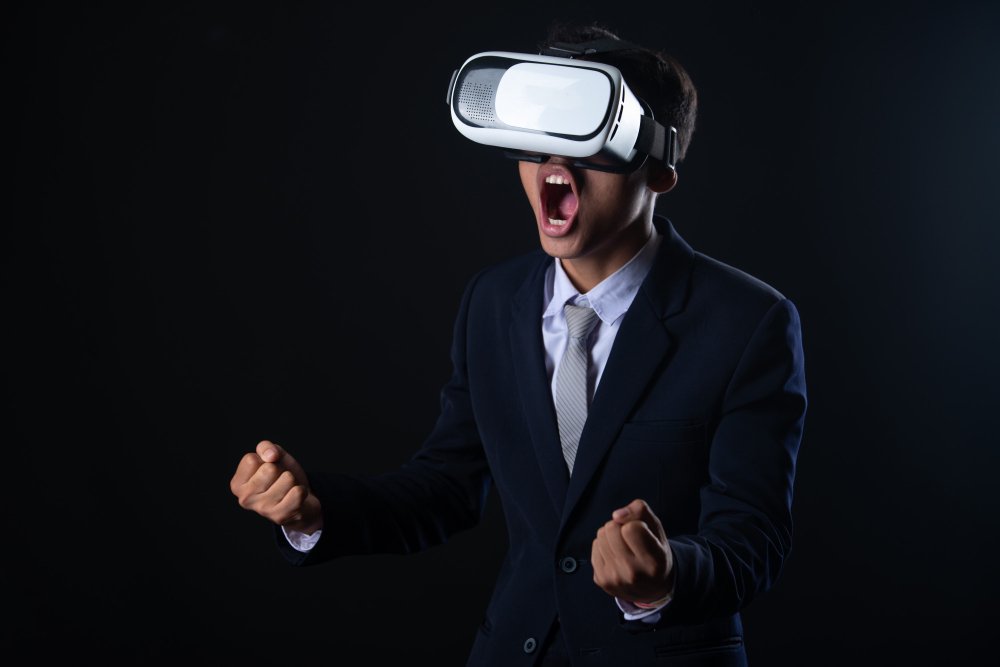
The test subject in the VR suit flinched—instinctively, not theatrically, as if a real object had just struck him—and there was a moment of collective silence. That subtle moment, captured during a private demo in late 2025, said more than any marketing deck ever could.
What had just happened wasn’t a special effect or a cinematic trick. It was a signal sent directly to his body—a carefully calibrated sensation mimicking the pulse of a virtual bullet. He felt the impact as well as saw it through a layer of cloth that was embedded with electro-muscle stimulation.
| Feature | Details |
|---|---|
| Launch Period | 2025–2026 |
| Main Technologies | Electro-muscle stimulation (EMS), vibrotactile motors, microfluidics |
| Leading Devices | Teslasuit, bHaptics TactSuit X40, Meta Reality Gloves, TrueGear ME02 |
| Core Sensations Delivered | Touch, temperature, weight, impact, pressure, resistance |
| Integrated Biometrics | Heart rate, stress levels, muscular feedback |
| Future Trends | “Ultra Haptics” using contactless ultrasound-based feedback |
| Primary Use Cases | Gaming, physical training, simulations, collaboration, remote presence |
| Notable Advantage | Full-body immersion with real-time response to digital environments |
Over the past year, virtual immersion has taken a remarkably effective leap forward. We’ve moved from simple vibrations to rich, multidimensional sensations. Devices like the Teslasuit and the bHaptics TactSuit X40 are equipped with dozens of tactile feedback points, delivering everything from simulated breezes to the harsh jolt of a digital collision.
Developers have enabled your arms to withstand virtual weight by integrating muscle contractions through EMS. Lifting a digital object? Your muscles tense up. Feeling rain in a scene? Tiny pulses simulate droplets dancing across your skin. It’s not flawless, but it’s strikingly convincing.
Meta’s Reality Gloves take things even further. They use microfluidic systems to simulate temperature and texture with surprising accuracy. Cold metal feels cold. Sandpaper has friction. These gloves aren’t just input tools—they’re sensory bridges.
During one demonstration, a developer asked me to reach for a virtual object that resembled a stone. As my hand wrapped around it, the glove resisted slightly and introduced a gritty sensation to my fingertips. For a moment, I forgot that nothing was there and instinctively tightened my grip.
That subtle illusion—the body responding to something it knows isn’t real—marks a turning point. And not just for developers or gamers. The implications are especially creative for educators, athletes, engineers, and therapists.
For instance, the TrueGear ME02 suit, which debuted last year, simulates both high-impact force and fine-tuned interaction by combining EMS with vibration motors. It’s being tested for physical rehabilitation, where precise muscular feedback supports movement training.
The Teslasuit, on the other hand, has an integrated biometric system that measures stress, detects heart rate, and dynamically modifies responses. A virtual environment doesn’t just react to what you do—it adjusts to how your body reacts. I found that both promising and a little disconcerting.
And here, I felt a quiet pause: when a machine understands your physical and emotional state better than your co-workers do, you start to wonder where the boundaries will be drawn.
Despite this, the benefits are tangible. During VR therapy trials, patients recovering from trauma report greater connection when touch—simulated or not—is part of the session. In high-performance training, athletes use these suits to replicate the tactile aspects of their sport without risking injury.
By leveraging real-time body data, developers are building experiences that are not just visually accurate but physically persuasive. Companies are already attempting to incorporate this technology into enterprise collaboration and education through strategic partnerships.
Of course, the technology is still evolving. Most suits have around 10 hours of battery life, and while they’re becoming lighter, you’ll still notice you’re wearing one. But every generation gets closer to seamless.
Affordability remains a challenge, though. Teslasuit, for instance, is still priced for enterprise use. Yet companies like bHaptics have found ways to deliver tactile suits compatible with consumer titles like Fortnite—an encouraging step toward broader access.
Security has become a topic of concern. Encryption is essential for devices that transmit and receive data through the body. The creators of Teslasuit assert that their systems employ military-grade safeguards to prevent outside interference. Even so, one can’t help but ask: if someone can hack your experience, what else can they influence?
However, there is no denying the excitement of the progress. Contactless haptics, sometimes referred to as “Ultra Haptics,” may become popular in the upcoming years. These devices create mid-air feedback using ultrasonic waves, so you can “feel” a surface without actually touching it.
I recently witnessed one of these prototypes in action. A small panel emitted ultrasonic waves toward a hovering hand. As the user moved, tiny air disturbances formed the shape of a button beneath their palm. The surprise on their face said it all. It’s not just impressive—it’s transformative.
Imagine sitting at your desk and feeling the texture of a virtual sample fabric without any gear on your hands. or shaking hands with a coworker five thousand miles away without having to put on a suit.
Incredibly versatile and increasingly immersive, these technologies are not merely reshaping digital engagement—they’re redefining what interaction means. Not as fantasy, but as a touchable, real-time experience.
I’ve covered technology for more than ten years, so I’ve witnessed numerous revolutions. Some had substance, while others were full of hype. This one has both of them. Furthermore, unlike previous promises, it is coming, point by point, pulse by pulse, rather than lurking on the horizon.
Disclaimer
Nothing published on Creative Learning Guild — including news articles, legal news, lawsuit summaries, settlement guides, legal analysis, financial commentary, expert opinion, educational content, or any other material — constitutes legal advice, financial advice, investment advice, or professional counsel of any kind. All content on this website is provided strictly for informational, educational, and news reporting purposes only. Consult your legal or financial advisor before taking any step.
