

Shortly after 8:00 AM on a calm Saturday morning, Highway 99 outside Delano transformed from a roadway into a parking lot of bent steel and blinking dangers. Thousands of commuters and long-distance vehicles were familiar with a section of California’s main thoroughfare, but it was suddenly engulfed in thick tule fog, which made brake lights nearly useless. Visibility has fallen to a hardly believable 100 feet in parts. In others, drivers said they could only see a few car lengths ahead. For those traveling north, time and traction evaporated simultaneously.
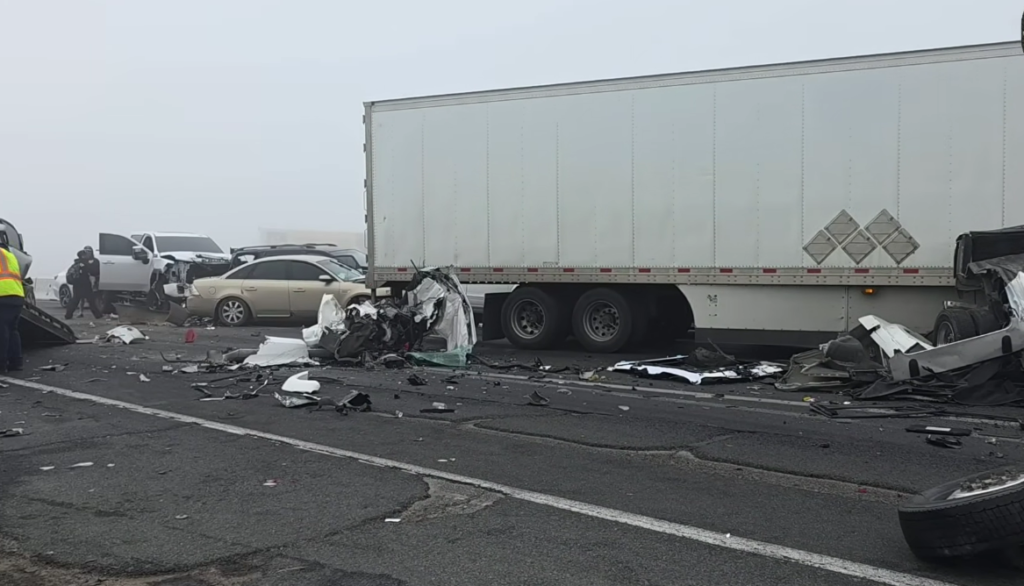
The result: a 59-vehicle pileup that left ten people injured, one with a moderate head wound, and the others with scrapes, bruises, and the quiet horror of what could have been. Dozens more were stranded for hours, bundled in jackets taken from backseats, waiting for the fog to lift or a tow vehicle to arrive.
Authorities moved quickly, sending firefighters from Tulare and Kern counties, CHP units, and Caltrans crews. After hours of methodically clearing the highway and directing cars through alternate escorts, all lanes had reopened by 2:30 PM. But the impact—physical and psychological—will last longer than the traffic delays.
In recent weeks, Central California has been stuck beneath an abnormally persistent blanket of fog. This seasonal phenomena, which meteorologists refer to as “tule fog,” is especially deadly due to its suddenness. When there is little wind, clear skies, and the soil cools just enough to retain moisture near the surface, it settles overnight. Drivers often go from safe cruising speed to full emergency stop within seconds.
| Date of Incident | January 31, 2026 |
|---|---|
| Location | Highway 99 between Delano and Earlimart, CA |
| Time of Incident | Approximately 8:15 AM |
| Vehicles Involved | 59 (originally estimated at 150) |
| Reported Injuries | 10 (1 moderate, 9 minor) |
| Primary Cause | Dense tule fog with 100–200 ft visibility |
| Roads Affected | Northbound and southbound lanes of Hwy 99 |
| Response Agencies | CHP, Caltrans, Tulare & Kern County fire crews |
| Reopened By | 2:30 PM Saturday |
| External Source | ABC News Report |
The phenomenon isn’t new, but this winter, it has seemed different. Since late November, the fog has failed to evaporate. A sluggish high-pressure system has crept over the region, trapping in cold, moist air like a lid on a pot. Satellite photographs taken weeks earlier revealed a ghostly belt of fog reaching hundreds of miles across the San Joaquin Valley. That same cloud was waiting for vehicles on Highway 99 this morning—calm, unbroken, and disturbingly familiar.
One Delano resident, Manuel Ortega, told me he was five minutes late leaving home today. That tiny delay likely saved him. “If I’d pulled out when I usually do,” he continued, “I’d have been right in the middle of it.” His voice held a mix of relief and residual worry. He chatted while stopped at a petrol station just off Cecil Avenue, sipping weak coffee and watching the emergency lights flicker in the distance.
While going along a frontage road near the crash site, I noted how eerily quiet it was. No yelling. No honking. Just the faint hum of generators and the crunch of broken glass under boots. The fog shrouded everything, imposing a kind of reverence that was both weird and oddly appropriate.
One thing I found very interesting was how several drivers—caught mid-pileup—left scribbled notes on their dashboards for the emergency responders. Notes like “No injuries. Waiting for tow.” or “Car still runs. Driver gone for help.” These were simple, practical signs, yet extremely effective in helping responders triage the chaos.
Drivers came to a “sudden wall of white,” according to CHP. Many were never able to respond. Jackknifed tractor trailers. Sideways, sedans whirled. Some automobiles ended up on shoulders, others smashed against guardrails. A few skidded entirely off the road and onto dirt embankments. Remarkably, considering the enormity of the disaster, no fatalities were reported. That outcome, although fortuitous, still left behind a tangle of shattered glass and twisted steel—a gallery of vehicles frozen mid-story.
The main concern today is how to prevent another one.
By incorporating more real-time sensors and illuminated warnings along fog-prone stretches, transportation officials seek to boost motorist awareness before danger completely materializes. These improvements, when completely applied, could become highly efficient in reducing injury and collision frequency during the following severe fog cycle.
For experienced Valley drivers, there’s a rhythm to fog season. Before getting dressed, you look at the windows. You account for slowdowns and reroutes. You anticipate diversions. But for newer drivers, or those inexperienced with tule fog, the conditions might be deceptively peaceful until they’re abruptly chaotic.
It’s not simply weather. It’s a pattern—repeating, intensifying, and compelling infrastructure to adjust.
When I spoke with a Caltrans worker during a brief lull in the cleanup, he mentioned that this was the third pileup he’d responded to this month. “They all look different,” he observed, “but the story’s usually the same—people going faster than they should, and fog that moves like a ghost.”
That line resonated with me for the rest of the day.
In the context of modern transportation safety, tule fog remains one of the trickiest variables to control. It doesn’t trigger alarms. It doesn’t register like snow or thunderstorms. But when it arrives, it changes everything instantaneously.
For now, the lanes are clear. The automobiles have been dragged away. Most drivers are home—some nursing wounds, some rewatching dashcam film, absorbing what they just lived through. And by tomorrow morning, it’s completely feasible that the fog will return, just as thick, just as quiet.
But something will have changed.
Every driver who was on that stretch of Highway 99 today will approach the next fogbank differently. Slower. More alert. Maybe even with hazard lights blinking long before brake lights are needed. And that shift—subtle but intentional—could make the difference between impact and escape.
This morning’s pileup wasn’t just a traffic story. It was a communal reminder, hidden in mist, of how easily routine may become ruin—and how adaptation, even delayed, remains our most effective instrument.
Disclaimer
Nothing published on Creative Learning Guild — including news articles, legal news, lawsuit summaries, settlement guides, legal analysis, financial commentary, expert opinion, educational content, or any other material — constitutes legal advice, financial advice, investment advice, or professional counsel of any kind. All content on this website is provided strictly for informational, educational, and news reporting purposes only. Consult your legal or financial advisor before taking any step.
