

At exactly 7:15 a.m., a low murmur rises along Choa Chu Kang Avenue 4. The security guard gives his well-known nod. Students with suitcases that appear to be heavier than them emerge as parents arrive and unbuckle their car belts. It’s a subdued, precise, and hospitable ballet of movement. There’s comfort in the ritual. Concord Primary takes its time. It readies.
Established in 2000, the school’s age is evident in its mature routines rather than its worn walls. It has boldly embraced its moniker. “Concord” means harmony, and here, that ideal doesn’t feel aspirational—it feels lived. Every morning greeting, every meticulous adjustment, and every quiet moment before assembly isn’t done for inspection. It’s routine combined with mindfulness practice.
Classrooms here aren’t a display of modernity. The tech is updated, yeah, but not to impress. Instead, it’s quietly effective. Students utilize tablets to encourage understanding, not to supplant instruction, and digital boards assist scheduled sessions. Concord’s usage of digital storytelling in lower primary courses, which combines oration, writing, and sketching, is particularly inventive. The result is exceptionally successful in increasing vocabulary and confidence, particularly in youngsters who are more reserved.
At this school, CCAs are more than just club lists. With its carefully designed layers, the CCA@Concord program allows students to freely explore, try new things, and leave politely if necessary. This independence, which is uncommon in settings that emphasize exams, has greatly decreased student burnout. I was informed by a Primary 4 girl that she “tried three CCAs before finding one that fits.” That kind of trial-and-error is not only allowed but encouraged, especially in foundational years when curiosity should dominate competition.
| Category | Details |
|---|---|
| Location | 3 Choa Chu Kang Avenue 4, Singapore 689814 |
| Founded | 2000 |
| School Type | Co-educational, Government Primary School |
| Principal | Not publicly listed (as of Jan 2026) |
| Motto | Not specified publicly |
| Distinctive Programmes | CCA@Concord, Character Education, ICT-based Learning |
| Known For | Inclusive culture, strong community engagement, harmony-focused values |
| Website | www.concordpri.moe.edu.sg |
The values are not abstract assertions here. Take “resilience”—often hard to define in youngsters. After the 2020 fire incident, where over 1,400 kids were evacuated, teachers didn’t merely run exercises. They invited pupils to write about the event. Some recalled smoke and commotion, but several noticed how calmly their friends reacted. Students learned resilience as a shared memory rather than as a lecture through group reflection.
For students with special learning disabilities, Concord doesn’t isolate—they integrate. Support teachers work discreetly within classrooms. Peers aren’t instructed to “be kind.” They’re trained to understand. The school’s focus on character education includes collaborative games where empathy is modeled more than taught. Observing this, I noted how students instinctively partnered with classmates who needed more time—without prodding. It made a subtle but enduring impression.
One morning, during snack break, I watched a teacher crouch beside a youngster struggling with a math worksheet. She asked him how his weekend went before pointing to the problem. That pause—anchored in human connection—seemed little yet shifted the tone. It brought to mind how frequently intellectual effort is preceded by emotional consent.
Concord’s discipline system avoids humiliation. Students are frequently prompted to write “restorative reflections” after making mistakes. These are structured letters discussing the incident, its effects, and other options—not repeated apologies. Students’ awareness has significantly increased as a result of this exercise, particularly those in Primary 5 and 6 who are learning to handle peer conflicts on their own.
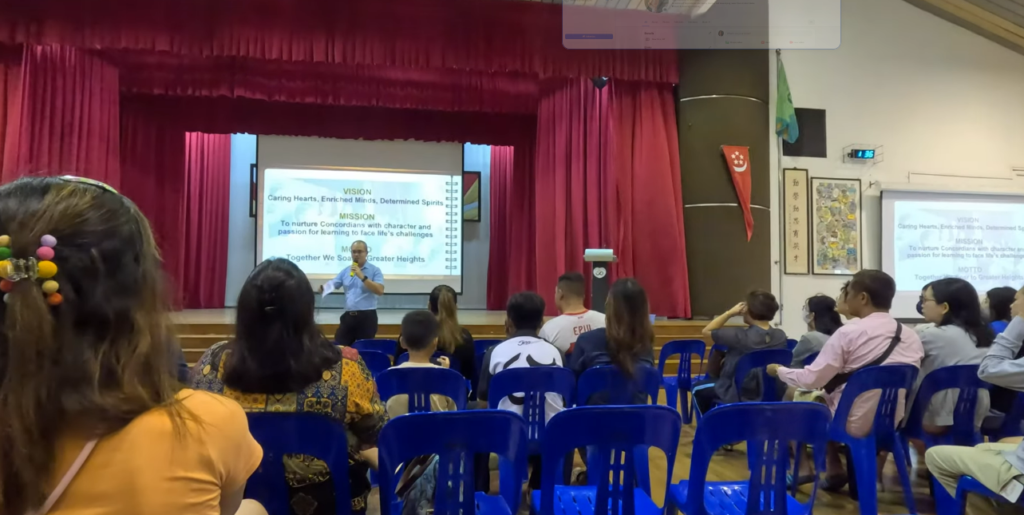
During a recent Open House, parents were encouraged to sit in for “mini-lessons.” A woman next to me murmured that this was her first time witnessing her son answer a question in front of a group. She refrained from crying. She blinked quickly, though. A key component of Concord’s philosophy is this form of communal visibility, where education is made public in a secure setting.
Over the past five years, the school has strengthened its ICT-based curriculum without over-relying on it. They have created a curriculum that is especially helpful for visual and kinesthetic learners by incorporating technology with science simulations, storytelling, and cultural discovery. As the principal once said, “The lesson is not technology.” It’s the vocabulary we employ to impart the knowledge.
“The Concord Creed” is a mural located in a more sedate area of the campus. It’s not ostentatious. It is nearly invisible because to its soft lines and pastel colors. However, before or after assemblies, students pause there, sometimes without realizing it. One child tapped it twice on his way to recess. I asked him why. “Just to remember to be better,” he remarked. Exceptionally clear. Nothing more is required.
While not all schools are perfect, Concord constantly seems to get the fundamentals right. It’s not about topping charts or impressing inspectors. It’s about forming enduring habits of perseverance, generosity, and presence. These don’t show up on league tables. But they show up in who pupils become.
Concord Primary has created an environment where growth is measured not only by grades but also by gestures by providing students with freedom to explore, room to ponder, and relationships based on trust. A confident “I’ll try again,” a patient nod, and an extended hand
And as I walked out one afternoon, a teacher waved at a pupil and said, “See you tomorrow, same awesome you.” The pupil nodded, smiled, and sprinted to the gate.
In its own subtle way, it was the ideal way to cap off a day that wasn’t particularly remarkable but was continuously, profoundly good.
Disclaimer
Nothing published on Creative Learning Guild — including news articles, legal news, lawsuit summaries, settlement guides, legal analysis, financial commentary, expert opinion, educational content, or any other material — constitutes legal advice, financial advice, investment advice, or professional counsel of any kind. All content on this website is provided strictly for informational, educational, and news reporting purposes only. Consult your legal or financial advisor before taking any step.
