

In Helsinki, there are no jarring bells or rushed roll calls on the first day of classes. Instead, kids congregate outside to solve puzzles that need strategy rather than speed, navigate enormous wooden blocks, and giggle in groups. It is less like a regular school and more like a scout camp. This fun beginning, however, astonishingly represents a strategic philosophy: learning is not a prerequisite for innovation. It’s creativity.
In the Nordic region, education is an active architect of economic growth rather than a background to it. In Finland, Denmark, and Norway, the goal of classroom design is to develop thinkers who can flourish in uncertainty rather than to establish rows and regulations. The policies are quite coherent, notwithstanding their imperfections. Instructors are trusted. Pupils have a voice. Listening is the first step toward innovation, not money.
This concept is unique in that it profoundly integrates everyday pedagogy with national innovation strategy. Skellefteå Universities Alliance leader Peter Mandalh emphasized the importance of “real alignment” between digital learning resources and real-world classroom issues at the Nordic EdTech Summit. It was very evident that technology should support instructors rather than divert them.
The partnership between the innovation office of Unicef and the Finnish EdTech startup Eduten is a clear example of this synergy. In Bhutanese classrooms, they introduced gamified math software that uses accurate answers to power vehicles that race across screens. It wasn’t showy. It worked really well. Students’ arithmetic proficiency increased by 11 points. Similar achievements were made in Uzbekistan and Laos. What’s the common thread? Every initiative was based on the needs expressed by the teachers.
In Nordic schools, colleagues adapt to a teacher taking a midterm mental health break without objecting. That is culture rather than policy. It’s what keeps teachers from burning out when they take innovative chances. Every forty-five minutes, schools give their children a fifteen-minute outdoor break. It seems contradictory in its rhythm. But by making room, they become more focused.
| Key Area | Summary |
|---|---|
| Topic | How Nordic Countries Align Education With Innovation Strategy |
| Region | Denmark, Finland, Sweden, Norway, Iceland |
| Core Focus | Integration of education policies with national innovation frameworks |
| Strategic Tools | EdTech, AI collaboration, teacher autonomy, state-university alliances |
| Key Institutions | Skellefteå Universities Alliance, Nordic EdTech Summit, Unicef OOI |
| Highlighted Results | Improved outcomes in pilot EdTech projects (e.g., Bhutan, Finland) |
| Notable Principles | Trust, balance, egalitarian classrooms, long-term planning |
| Source Reference | https://www.gettingsmart.com and Financial Times UNICEF Partnership |
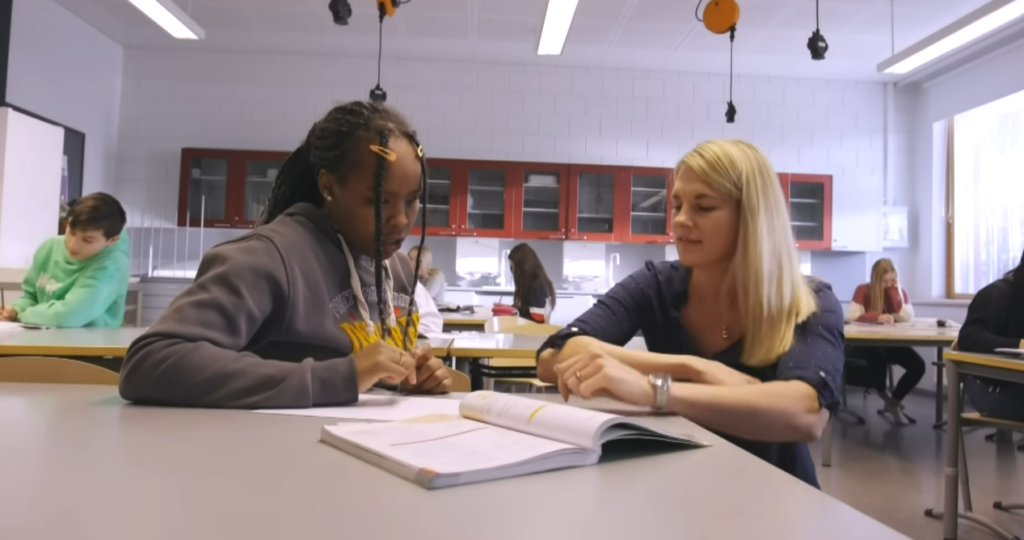
This culture is carried into advanced research by Norwegian and Swedish institutions through strategic cooperation. State agendas are strongly linked to labs that specialize on robots, inclusive healthcare, and climate technology. However, they allow for innovation, unlike inflexible bureaucracies. Professors frequently work with local governments, international NGOs, and AI businesses. Their efforts are not isolated. It’s used.
Both social resilience and academic performance have significantly increased as a result of this all-encompassing approach. For example, a project in Denmark used satellite data processed by high school students to monitor groundwater levels in East Africa. That same project directly influenced the design of international humanitarian efforts. It had both scholarly and real-world effects.
Importantly, Nordic nations do not view technology as a panacea. Does it foster human connection, they inquire? The use of Finnish AI textbooks to help impaired students personalize their educational experience in Uruguay was one particularly noteworthy case. Quietly and accurately, the platform adjusted tempo, language, and tone to each learner’s pace.
In this case, even the private sector acts differently. Innovation grants in Sweden support femtech and maternal health firms by allowing them to test their concepts in actual classroom settings in addition to pitching them. Gender parity is a primary objective. Both national goals and financing metrics incorporate it. With its emphasis on design rather than disruption, the strategy seems especially novel.
This slow-build approach stands in stark contrast to other fast-scaling strategies. Nordic innovation tends to take its time. A pilot project is insufficient unless it is both significant and long-lasting. It doesn’t scale if it doesn’t help educators.
Some Danish schools now efficiently and transparently manage student records by integrating blockchain platforms, which significantly lowers administrative overhead. It’s a seemingly insignificant action that conveys a more significant goal: creating long-lasting systems.
“What problem do you want to solve?” is a common question posed to the students. The question isn’t rhetorical. Students in upper-secondary institutions put up real business concepts, some of which are financed by municipal incubators. As societal contributions, not as competition fuel. For school buses, one group created pollution monitors. Another worked on apps that translate text for pupils who are refugees. Their inventions were extremely adaptable.
Teachers continue to play a key role in this innovation ecosystem. Their opinions influence legislation, training, and even procurement. A rural principal serving on a national EdTech committee is not uncommon. It’s a very effective model—less red tape, more tangible advancement.
Neither technology nor policy alone is the key to this alignment. It’s the belief that the most powerful force behind national development is education, given the right kind of support. This belief is shown in subtle choices like encouraging curiosity, creating for balance, and having faith in educators.
Over the last ten years, Nordic systems have remained patient as discussions about global education have become more vocal. They may have appeared to evolve slowly. These identical techniques, however, are now highly regarded, astonishingly effective, and incredibly durable.
Furthermore, many nations are not debating whether to embrace EdTech as we look to a future characterized by digital transitions, climate urgency, and demographic shifts. It is their willingness to reconsider education as a lever rather than a service and as a central national plan.
Nordic nations already do.
Disclaimer
Nothing published on Creative Learning Guild — including news articles, legal news, lawsuit summaries, settlement guides, legal analysis, financial commentary, expert opinion, educational content, or any other material — constitutes legal advice, financial advice, investment advice, or professional counsel of any kind. All content on this website is provided strictly for informational, educational, and news reporting purposes only. Consult your legal or financial advisor before taking any step.
