

For a considerable portion of her career, Ellen Glickman advanced through academia in a manner typical of an experienced researcher: calmly, methodically, and mostly out of the public eye. She produced work that gained influence gradually rather than noisily, like sediment building strength layer by layer.
Environmental physiology is her specialty, and it’s especially harsh. It looks at how the body responds to stressors like heat, cold, dehydration, and oxygen deprivation—conditions that reveal weaknesses immediately and reward preparation even more swiftly. Her reputation and her scholarship were shaped over decades by that focus.
Glickman gained a reputation at Kent State University for being a demanding individual with very clear expectations and a research agenda that was astonishingly successful in drawing funds, citations, and graduate students who were prepared to take on challenging tasks without taking short cuts.
Her publishing record over the last thirty years has significantly advanced our knowledge of how human performance reacts to environmental extremes, with findings that have been especially helpful to clinical exercise physiology, wilderness medicine, and military research.
| Detail | Information |
|---|---|
| Name | Ellen Glickman |
| Institution | Kent State University |
| Position | Professor, School of Health Sciences |
| Field | Exercise & Environmental Physiology |
| Academic Tenure | Joined Kent State faculty in 1995 |
| Notable Recognition | Fellow of the American College of Sports Medicine |
| Research Output | ~100 peer‑reviewed publications |
| Public Incident | Campus arrest in May 2024; charges later dismissed |
| External Reference | Kent State Faculty Profile – kent.edu |
Naturally, administrative positions came next. She approached leadership with the same seriousness she did lab work, which required patience, credibility, and an incredibly dependable understanding of process—qualities necessary for running a school within a huge public university.
On May 9, 2024, that lengthy arc curved sharply.
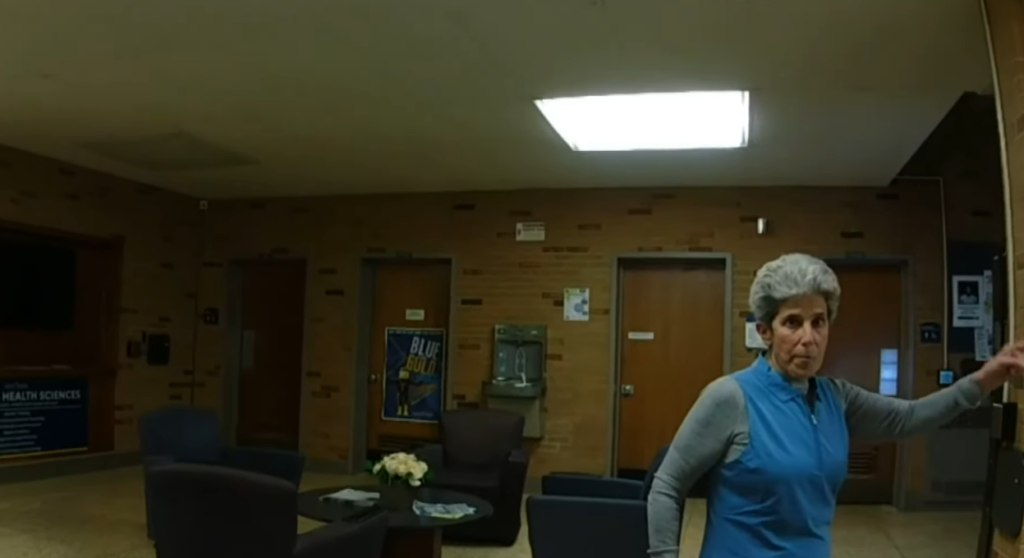
When Glickman was locked out of the Health Sciences building, Nixson Hall, the night after commencement, she called campus police for help. Because of observations, presumptions, and hastily made decisions, what should have been a regular exchange swiftly became more complex.
The conversation was recorded via a body camera. It was proof within hours. It became a spectacle after a few months.
Glickman was arrested by police for disorderly conduct while intoxicated. She denied being drunk and then clarified that the symptoms were quite comparable to impairment due to kidney disease, dehydration, fatigue, and pain. Despite admitting to having had one drink earlier, she insisted it was not the cause.
The result was simple from a legal standpoint. Charges were dropped. Information was later erased. After considering her impeccable professional background, a judge determined that there was little public interest in further documentation.
The results were far from straightforward in terms of reputation.
The video reappeared online after being modified and repackaged by commentary channels, whose audience grew much more quickly than any official editing procedure. View counts increased. The context became weaker. Criticism sharpened.
Like a swarm of bees, online conversation is dispersed, powerful, and almost impossible to reroute once it gains traction.
Consequences ensued throughout the university. Glickman’s position as director was taken away, and she was given full-time faculty responsibilities. Official remarks placed more emphasis on process than personality, which was intended to be neutral but was perceived by many as alienating.
Pupils’ responses varied. She was defended by others by pointing to her years of academic rigor and mentoring. Others went back to their complaints, fusing their impressions from a viral video with their classroom experiences. Many of the evaluations and ratings were written after the video received fresh attention, and they grew quickly.
I found it very illuminating when long-form reputation collided with short-form judgment.
But the actual job continued.
The lectures have resumed. Protocols in the lab resumed. Students kept submitting data sets, posing inquiries, and getting ready for professions influenced in part by the studies she contributed to. The academic life was particularly durable in the more subdued environment.
Her research record has not been altered. Almost four thousand citations. requests to review for prestigious publications. contributions that over time greatly closed the knowledge gaps in human performance and environmental stress physiology.
This incident could be framed as a fall from grace. That view leaves out a crucial detail.
This is also a tale of personal reorientation and institutional perseverance. With experience honed by examination, Glickman went back to teaching, navigating a new setting while delivering content that is remarkably timeless.
Accountability and proportionality have been difficult for institutions to reconcile in recent years. While academic careers take decades to develop, viral moments condense complexity into seconds. Institutions are still learning how to handle the tension caused by this mismatch.
That inequality is brought to light in an unsettling way by Glickman’s case.
No one is immune from mistakes because of authority. However, particularly when judicial systems have already settled the issue, a career developed through consistent service shouldn’t be destroyed by a single incident.
Instead of freezing people at their worst-perceived moment, a more positive topic emerges: how organizations and communities move forward following criticism.
Glickman’s teaching career continues. Learning never stops for students. Research is still in circulation.
That tenacity hints to something subtly hopeful: that knowledge, albeit shattered, is not easily lost, and that one’s professional identity can change, becoming noticeably stronger via introspection rather than irreversibly weakened by exposure.
In the realm of academia, advancement is rarely smooth. Revision, reevaluation, and ongoing work are how it comes.
Disclaimer
Nothing published on Creative Learning Guild — including news articles, legal news, lawsuit summaries, settlement guides, legal analysis, financial commentary, expert opinion, educational content, or any other material — constitutes legal advice, financial advice, investment advice, or professional counsel of any kind. All content on this website is provided strictly for informational, educational, and news reporting purposes only. Consult your legal or financial advisor before taking any step.
