

During a visit to the White House, María Corina Machado placed her Nobel Peace Prize medal in Donald Trump’s hands. This was not simply an odd gesture; it was a remarkable disruption of a century-old precedent. In an attempt to commemorate what she saw as a crucial part in Venezuela’s democratic transition, she made a symbolic step. Confusion, public mockery, and institutional clarification, however, were the next steps.
By giving out the Peace Prize, the Norwegian committee renders a single, definitive decision. Neither the laureate nor anybody else can reverse, change, or prolong that decision. This stance was swiftly and quietly reinforced by the Nobel Institute, which released a statement that was unambiguous: “The decision is final and stands for all time.”
Trump took the medal with a broad smile, holding it up like a prize, in spite of that clarity. His previous statements that he deserved the prize had a remarkably similar ripple effect to the photo that made headlines. Even though this event had little procedural significance, it was politically helpful to him.
| Year Established | 1895 |
|---|---|
| First Awarded | December 10, 1901 |
| Location | Oslo, Norway |
| Recent Winner | María Corina Machado (2025) |
| Notable Rule | Cannot be revoked, shared, or transferred |
| Most Awards | International Red Cross (3) |
| Official Site | nobelpeaceprize.org |
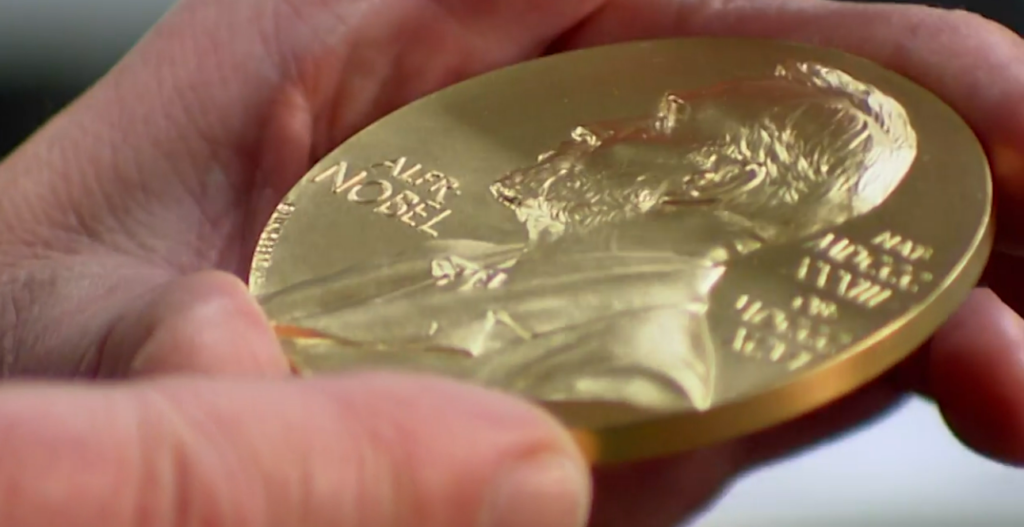
The public’s response was quick and especially incisive on the internet. While some criticized the interaction as staged, others questioned Machado’s morality. As many rightly pointed out, the Nobel Peace Prize is more than just gold and engraving. It is a designation that is the result of a stringent selection procedure based on legacy and intent. Furthermore, once granted, it cannot be recycled, sold, or given away again.
Machado might have interpreted her action as an expression of gratitude given the intense strain he was under at home and the weight of the opposition movement in Venezuela. She claimed that Maduro’s detention was mostly due to Trump, calling his backing “historic” and “crucial” for her nation’s future. Her speech put the Nobel Committee in an unexpectedly unpleasant position, regardless of whether she was motivated by political strategy or personal respect.
Remarkably, Machado did not have Trump’s political support at the time. Rather, he expressed his support for Delcy Rodríguez, another important figure in the future of Venezuela. He complimented Machado as “a very nice woman” in media appearances, but questioned if she was still a good leader. This paradox—accepting a medal without supporting the person who awarded it—created an ironic contrast that was not overlooked.
Both parties optimized the attention the moment would garner by carefully crafting their image and timing it. However, only one—and it wasn’t the institution—came out with their reputation completely unscathed. The Nobel Peace Prize, which was previously only given to organizations like Malala Yousafzai, the Red Cross, and Nelson Mandela, was abruptly ensnared in political theater. It does not typically hold that position.
During the first news story, I recall thinking it was like witnessing someone return an Olympic medal in the middle of a race and give it to the person they most respected in the audience. Emotional and possibly even noble in spirit, it clashes with structure.
The reputation of international accolades has significantly diminished over the last ten years. Once-rigid boundaries have been dissolved by social media, quick political turnover, and increasingly hazy distinctions between support and recognition. Nevertheless, the Nobel Peace Prize continues to be incredibly successful in highlighting individuals whose efforts go beyond noise—those making genuine, observable change.
Machado might have wanted to draw attention to her cause internationally by incorporating this gesture into a media plan. She probably didn’t realize how much institutional friction it would cause. Nobel awards are, after all, recognitions of diplomacy, not instruments for it.
In a time of rapid narrative, this event also highlights the brittleness of meaning. It is both amazing and unnerving how quickly meaning may change in the everyday trading of symbols. However, the Nobel Peace Prize has survived largely due to the clarity with which it preserves its heritage.
Here, it’s not just about who gets the prize; it’s also about why it can’t be distributed like a business card.
Heads of state, grassroots activists, and entire organizations have all been honored since the prize’s inception. Not celebrity, but a proven impact—often at significant personal cost—is what unites them. As a result, the distinction takes precedence over the award, notwithstanding its elegance.
Trump does not currently have the Nobel Peace Prize, but he does have a Nobel medal. It’s a very noticeable difference.
Furthermore, perhaps the committee’s tough stance will deter any reinterpretation of what is still a highly protected custom the next time a comparable exchange is suggested. Maintaining a legacy, particularly one that is based on peace, requires more than just formalities. It requires regularity.
Disclaimer
Nothing published on Creative Learning Guild — including news articles, legal news, lawsuit summaries, settlement guides, legal analysis, financial commentary, expert opinion, educational content, or any other material — constitutes legal advice, financial advice, investment advice, or professional counsel of any kind. All content on this website is provided strictly for informational, educational, and news reporting purposes only. Consult your legal or financial advisor before taking any step.
