

Imagine whispering to a robot, “Build me a crab that can walk sideways,” and watching as it obediently puts the pieces together to create an incredibly realistic-looking object. That scene, which was previously only seen in science fiction films, is now being acted out in university labs where self-designing machines are actively changing our conception of creation.
These aren’t preprogrammed robots that adhere to specific guidelines. They hear you. They decipher. Then they build, which is amazing.
Modular robots and sophisticated language models are at the heart of this change. Users are able to express their desired robot type in natural speech using systems such as DeepMind’s inner-voice-enabled frameworks and Duke’s Text2Robot. After that, the algorithm creates a workable design—often in a matter of seconds—and uses reusable or 3D-printed parts to build it. Just a discussion, no engineering degree, no code.
Rapid prototyping teams, emergency responders, and educators will find the implications especially intriguing. These technologies remove obstacles between concept and execution by fusing mechanical logic with natural language. They enable users to express their ideas and watch them come to life.
Zero-shot learning for robotic tasks is an advancement made by DeepMind in the last year. These machines just need spoken instructions to execute novel tasks they have never seen before. In one instance, a robot was instructed to “Pick up the red one on the left,” and it was able to correctly grasp an unknown object. Just a few years ago, that kind of contextual comprehension would have taken weeks of instruction.
| Feature | Detail |
|---|---|
| Technology | Natural-language AI + modular robotics |
| Development Origin | MIT + Duke University (Text2Robot, DeepMind integrations) |
| Input Method | Spoken voice commands |
| Output Capability | Functional 3D robot designs and real-world assembly using building blocks |
| Notable Advantage | No prior training data needed, fully customizable |
| Future Applications | Education, disaster response, rapid prototyping |
| Related Technologies | Acoustic swarm bots, self-healing microrobots, zero-shot learning |
| External Link | New Scientist article |
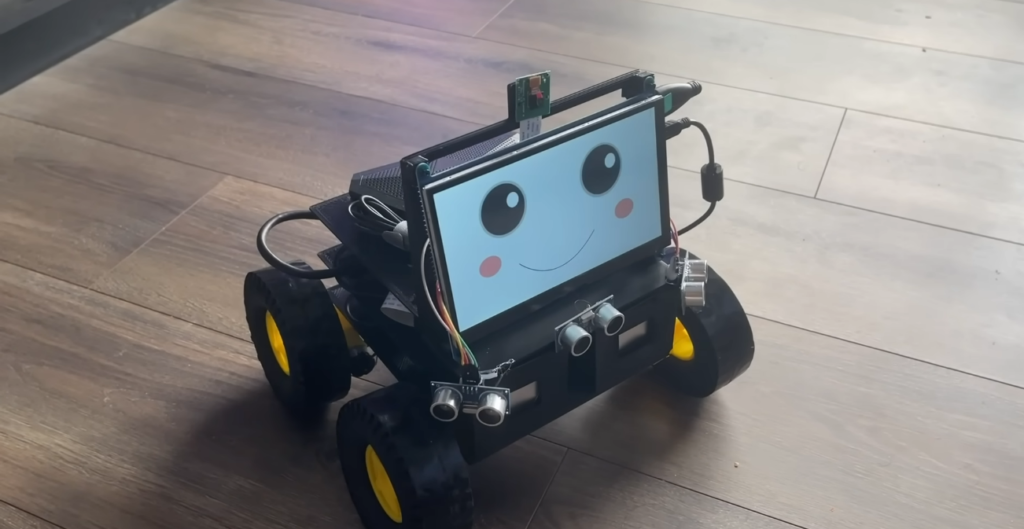
To further advance this development, MIT researchers integrated AI command processing with block-based assembly technology, allowing a robot to react to structural commands such as “make a table with four short legs” or “build a ramp I can roll a ball down.” The intention was comprehended by the robot in addition to the language.
By utilizing modularity, the system maintains its remarkable versatility. Similar to a child building with LEGOs but with sophisticated problem-solving abilities built on top, each brick serves as a unit of function—mobility, stability, and shape—allowing the machine to think spatially.
The cost-effectiveness of this is what makes it even more attractive. Design cycles are shortened from weeks to hours because to the platforms, which also enable large-scale idea testing remarkably inexpensive. Academic institutions or startup labs with limited funding can especially benefit from this.
The ability of microscopic agents to communicate in swarms using only sound waves and simple motors is astounding, according to recent Penn State microrobot study. Inspired by the way bees or birds work in groups, these robots use sound cues to find their way around, adjust, and even reassemble if they break. These “acoustic swarms” may one day be used to transport medication deep within the human body or clean up contaminated areas, according to scientists.
A basic oscillator, speaker, and microphone are included with every microrobot. When combined, they produce what experts refer to as emergent behavior, which is when individual robots sense the signals of their peers, synchronize, and move as a single unit. It’s an incredibly powerful method for controlling large-scale behavior with little intricacy.
During one of these simulations, I recall being amazed at how much it resembled a starling murmuration—chaotic yet cohesive. It got me thinking about whether intelligence is more about harmonizing with others than it is about internal calculations.
The shift from command-based robots to collaboration-based systems is what we’re seeing on a larger scale. Rather than giving exact, code-heavy instructions, we converse with machines. The robot starts to act more like a participant and less like a tool.
This evolution brings up significant design ethics. Should what can be requested be restricted? Can robots be trained to disregard orders that are harmful or illogical? How can we help self-building systems develop trust?
For the time being, those inquiries linger just above the surface. Engineers are concentrating on evaluating novel assembly formats, enhancing memory, and fine-tuning response. The trajectory, however, is clear. Previously hand-held machines are now responding to spoken commands, adapting quickly, and getting better with time.
Like rotary phones or DOS prompts, keyboards and programming languages may be viewed as transitional artifacts. Instead, a world where voice, intent, and design coexist harmoniously—where invention is as quick as speech—is beginning to emerge.
What’s even more intriguing is how fast the robot learns to listen, rather than what it can construct.
Disclaimer
Nothing published on Creative Learning Guild — including news articles, legal news, lawsuit summaries, settlement guides, legal analysis, financial commentary, expert opinion, educational content, or any other material — constitutes legal advice, financial advice, investment advice, or professional counsel of any kind. All content on this website is provided strictly for informational, educational, and news reporting purposes only. Consult your legal or financial advisor before taking any step.
